
Digital axis
Excerpt
Project : RégéNexus, towards a sustainability-oriented cyber-physical system to improve the efficiency and cooperation of recycling stakeholders in a context of sovereignty
Pascale MARANGÉ, Senior lecturer CRAN
Contact : pascale.marange@univ-lorraine.fr
Launch date : 15/10/2025
Reference :
The RegeNexus project aims to design an agile and interconnected digital ecosystem that promotes sustainability, sovereignty, and efficiency in recycling industries. It is based on the concept of systems of systems, structuring value chains as multi-stakeholder networks capable of cooperating despite different objectives, constraints, and timeframes. One of the major challenges of the project lies in decision-making at several levels: at the nano level, to characterize the material and guide its sorting and processing; at the micro level, to guide the technical and economic choices of companies; and at the macro level, to manage the global value chain in a logic of strategic planning and coordination between actors.
The RegeNexus project relies on advanced digital solutions, including digital twins, multi-agent modeling, artificial intelligence, and the Internet of Things, to improve flow traceability, behavior prediction, and dynamic reconfiguration of value chains. These decisions must be made on the basis of heterogeneous, incomplete, and even uncertain data from sensors, field observations, business expertise, or projections. This requires the development of multi-scale, multi-criteria decision support tools capable of combining qualitative and quantitative indicators, taking into account the delayed timing of certain impacts (e.g., the deferred environmental benefits of a regeneration strategy).
Specific issues such as automated recognition of complex materials using hyperspectral imaging and AI, and territorial modeling of waste flows and interactions between public and private actors are being studied. The proposed contributions are to be validated in several concrete applications, particularly in the fields of plastics, textiles, batteries, and household waste. By mobilizing a multidisciplinary consortium and combining engineering, digital science, and industrial approaches, the RegeNexus project aims to design and specify a robust methodological framework for more connected, resilient, and truly sustainable recycling.
Keywords: Circular Economy, Value Chain, Systems Engineering, Decision Support, Digital Twin, Image Processing, Artificial Intelligence, Sovereignty Digital
Tasks
Our researches
Design and reconfiguration of value chains
Chiara Franciosi (CRAN – Université de Lorraine)
Design recycling value chain architectures as systems of systems, integrating interactions between actors, flows, and digital infrastructures.
Assessment and decision-making methods and tools
Valérie Botta (DISP – INSA Lyon)
Develop multi-level decision support and simulation tools (digital twins, AI, optimization) to assess environmental and economic performance.
Validation and use cases
Ludovic Koehl (GEMTEX – ENSAIT)
Test approaches on specific cases (plastics, textiles, batteries) and assess transferability to other sectors.
Key-numbers
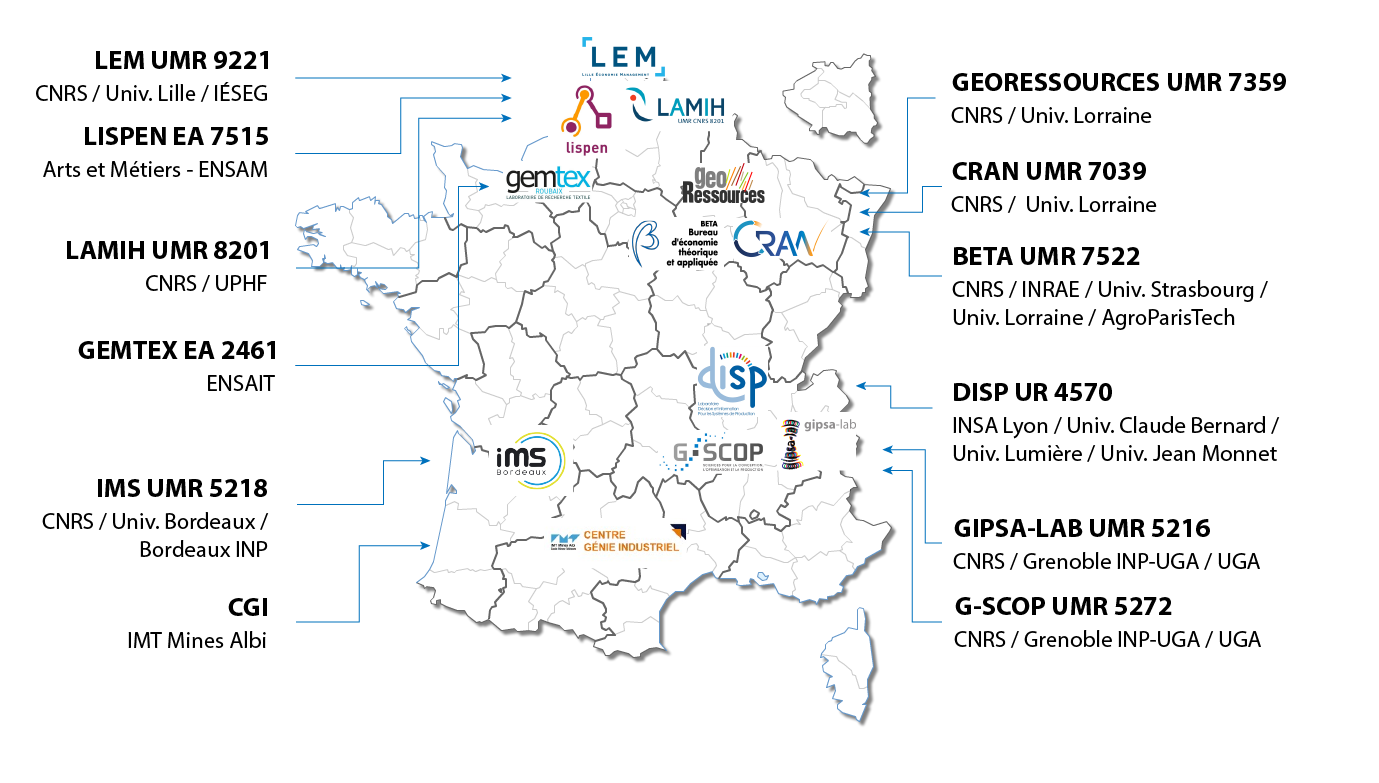
Laboratories
Researchers
Total budget
Consortium
- Methodologies for designing circular value chains as systems of systems.
- Development of multi–scale, multi–criteria models that integrate uncertainties and deferred temporalities.
- Development of image processing and artificial intelligence approaches to improve sorting.
- Integration of digital twins and sustainable decision–making tools.
- Assessment of the economic, social, and environmental impact of digital solutions on recycling.
- Creation of a generic methodological framework that can be transferred between sectors.
RégéNexus contributes to reducing material losses and improving circularity through better coordination between stakeholders and the simulation of recycling scenarios.
The tools developed will make it possible to measure the environmental benefits of regeneration and reuse, while limiting the rebound effects associated with digital technology.
- 7 doctoral theses
- 5 post–doctorates
- 1 research engineer
- 1 design engineer
Axis news
No news