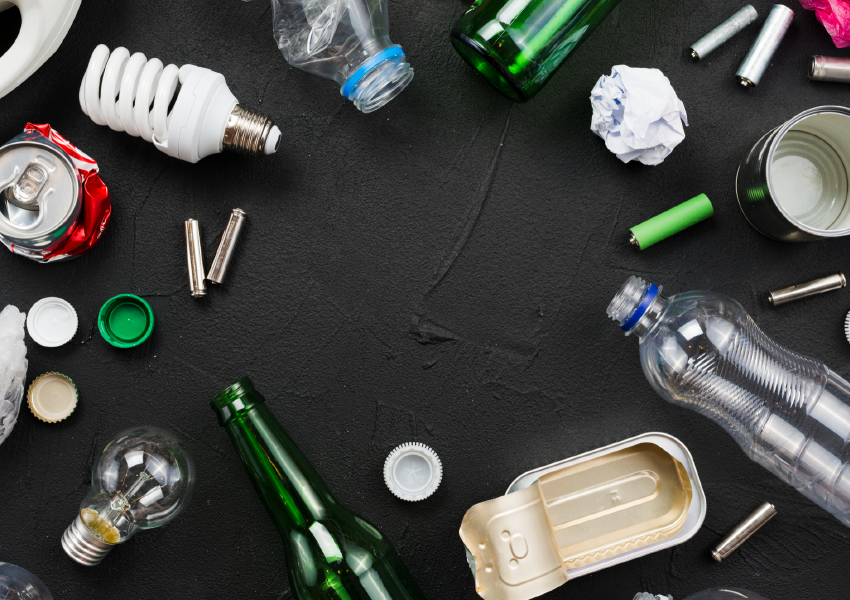
Household Waste axis
Project Phase 1
Household Waste
The overall objective of the Household Waste project is to acquire the knowledge needed to improve household waste recycling across the entire value chain, from collection to treatment and recycling, and the recovery and/or disposal of final waste.
Project Phase 2
DETEXMEN
The DETEXMEN project targets complex household textile waste, a rapidly growing waste stream driven by fast fashion. It seeks to develop innovative technological approaches optimized for reusing and embellishing collected complex textile products, and to assess the associated environmental impacts of these processes.
Household Waste – Project phase 1
Excerpt
Project : Household waste, systemic analysis
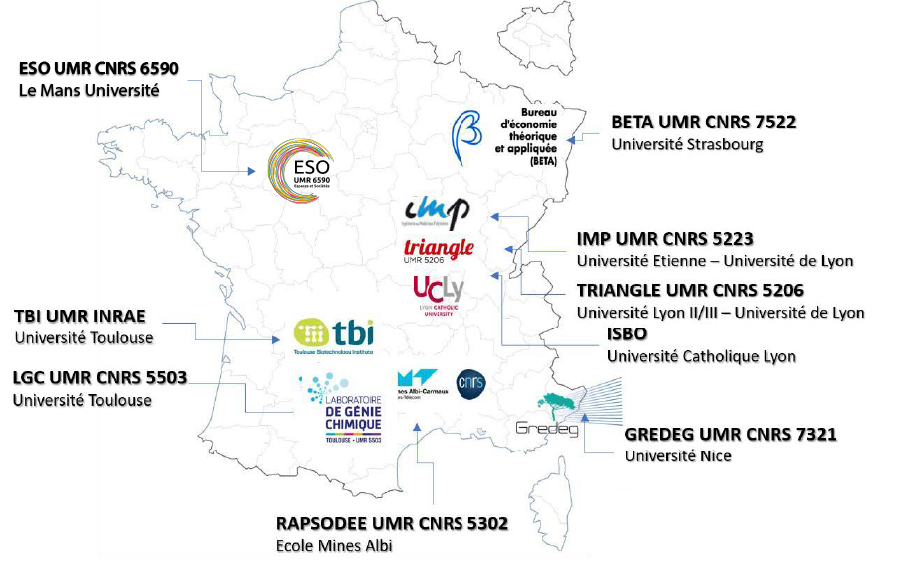
Ligia BARNA, Professor (TBI)
Contact : lbarna@insa-toulouse.fr
Yvan CHALAMET, Professor (IMP)
Contact : yvan.chalamet@univ-st-etienne.fr
Launch date : 30/03/2023
Reference : ANR-22-PERE-0010
The overall aim of the project is to acquire the knowledge needed to improve household waste recycling along the entire value chain, from collection to treatment and recycling, and the recovery and/or disposal of final waste. The project is structured around five themes. The first combines technology and social behavior to improve the sorting of household waste materials. The second focuses on innovative processes for decontaminating materials. Value chains are studied from the point of view of material/energy flows, logistics and environmental impacts. A fourth theme studies human behavior, organizational dynamics and the interconnections between players in a given area, and proposes ways of improving the structure of value chains. Finally, the role of regulation and standardization in recycling and waste sorting is analyzed.
Keywords: Cleaning/purification processes, Sorting processes, Waste characterization, Waste collection, Life cycle assessment, Economic players, Player dynamics, Regulation and standardization, Non-financial incentives, Individual behaviour
Tasks
Our researches
Innovative sorting for optimum material separation
Mathieu Durand, ESO
Sandrine Bacconnier, ESO
Combines technology and social behavior to improve waste separation. The aim is first to map and analyze the tools available to promote sorting in companies producing household waste. Then, separation technology is addressed through multi-view/multi-sensor and dual-energy X-ray images.
Innovative preparations for extensive reuse of materials
Yvan Chalamet, IMP
Aims to develop deinking/purification methods that limit the use of organic solvents (replaced by supercritical fluids) and promote efficient purification methods enabling the reuse of these materials for new applications.
Systems modeling and analysis
Pascal Guiraud, TBI
Modeling approaches and tools are needed to better integrate all aspects, from waste traceability to efficient recycling and reuse. Task 3 analyzes and optimizes value chains through material flow analysis (MFA), mathematical modeling and logistics optimization, economic evaluation and life cycle assessment (LCA).
Dynamics of actors and organizations
Lesly Cassin, BETA
Examines human behavior, the dynamics of actors and organizations, the interconnections of actors on the territory, and proposes ways to improve the structure of value chains. We’ll discover the extent to which supply chain design helps organize industries/communities/homes from geographic, political, social, environmental and economic perspectives.
Regulation, standardization
Nathalie Lazaric, GREDEG
Examines the role of regulation and standardization on human behavior with regard to recycling and waste separation, as well as on the development of new material channels.
Key numbers
Laboratories
Researchers
Total budget
Consortium
This project is expected to deliver results on several levels. Firstly, an interdisciplinary approach should emerge through the collaboration of researchers from different scientific backgrounds. The work carried out will lead to technological proposals for improving the recyclability of materials contained in household waste. The modeling of waste streams from collection to recycling will make it possible to propose methodologies for the systemic analysis of waste management methods. Identifying and analyzing the socio-economic and regulatory obstacles to an efficient circular economy will enable us to understand the contribution of individuals, companies and institutions, and thus propose levers for action to improve waste reduction and material circularity.
The research carried out as part of this project aims to improve the environmental impact of household waste management by acting at different points in the life cycle of objects and waste. Firstly, by studying how to influence consumer behavior to reduce the production of household waste. Secondly, by improving sorting at home. The dynamics and logistics of collection networks can be optimized, as can the choice of recycling/super-recycling channels. Finally, technical improvements in waste sorting and recyclability will enable more efficient recycling, with gains in the environmental performance of the channels.
The project is largely based on training through research and consolidating the high-level skills of young graduates as post-docs. The project will involve 9 post-docs (138 months).
DETEXMEN – Project phase 2
Excerpt
Project : DETEXMEN, Household textile waste: production, impact, and recovery
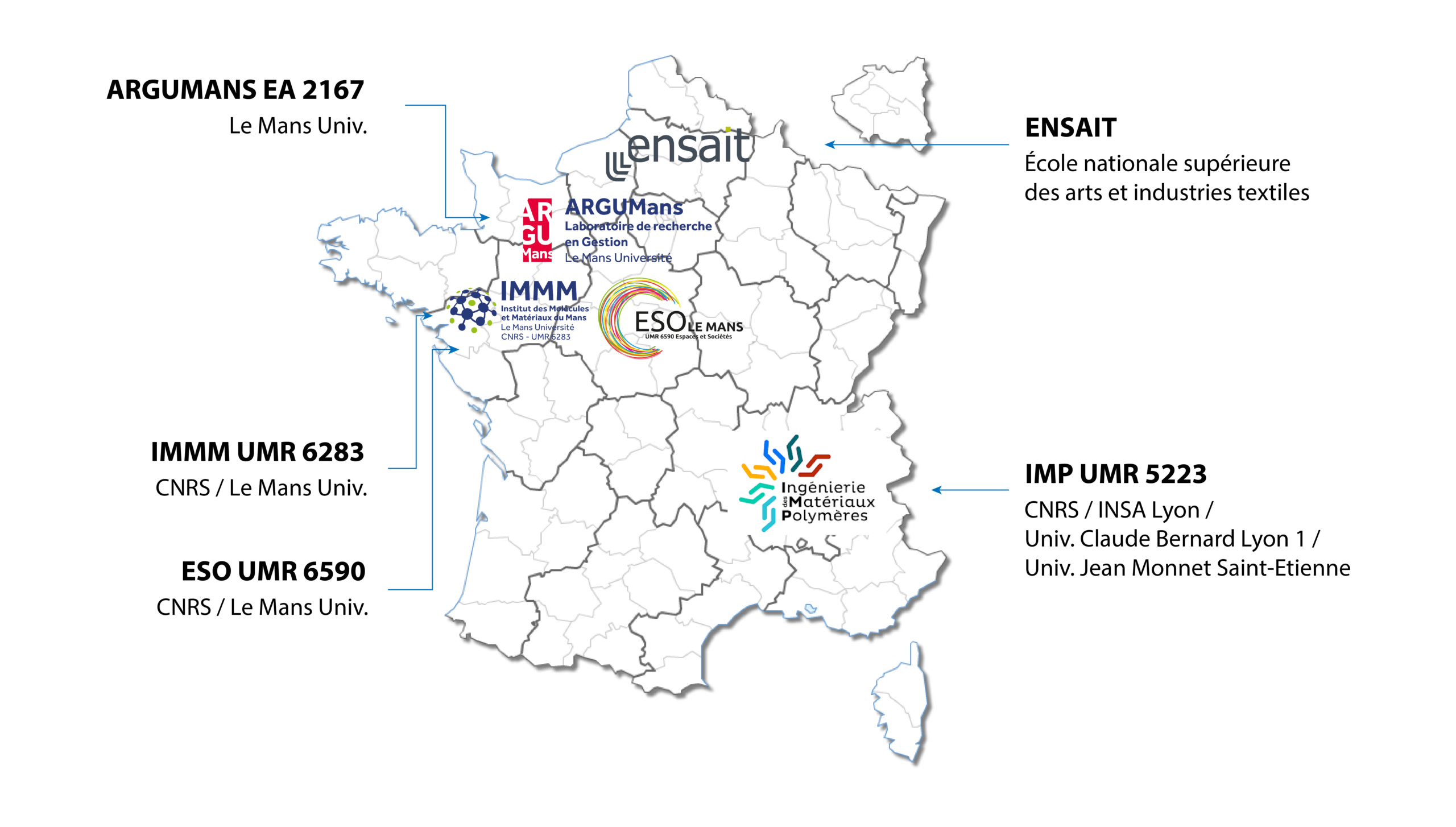
Gonzalez, Christine, Professor (ARGUMANS)
Contact : christine.gonzalez@univ-lemans.fr
Launch date: 01/04/2026
Reference:
The DETEXMEN project targets complex household textile waste, a rapidly growing stream driven by fast fashion. It seeks to develop innovative technological approaches optimized for reusing and embellishing complex textile products collected to produce a second-life product that appeals to potential customers, and to assess the associated environmental impacts of these processes.
The DETEXMEN project also seeks to understand how to increase the amount of textiles collected. This involves highlighting the underlying factors in individuals’ clothing recycling behaviors and assessing how digital tools can support and improve these practices. It also aims to determine whether providing information on the recyclability and environmental impact of textiles via a dedicated mobile app can effectively influence consumers’ recycling and purchasing decisions.
This work integrates social, environmental, and technological dimensions to establish the scientific basis for a short-loop reuse strategy, paving the way for future developments at a higher level of technological maturity and supporting the transition to circular textile systems.
Key words: Textiles, Complex household waste, Contamination, Recycling behavior, Environmental justice, Recovery, Reuse, Digital
Tasks
Our researches
Consumer behavior and digital tools
Christine Gonzalez (ARGUMANS-Le Mans Université) and Mathieu Durand (ESO, Le Mans)
Understanding the macro, meso, and micro determinants of clothing recycling behavior and the role that digital tools can play.
Eco-friendly applications in the clothing sector have been little studied. The question arises as to what incentive these digital tools can provide, taking into account micro, meso, and macro levels and environmental inequalities. It will also be necessary to understand which features can influence the relationship that individuals have with these applications and their use to improve textile recycling.
Recycling and reuse of textiles
Massika BEHARY (ENSAIT-ULille)
Innovative treatment for the short-loop reuse of complex household textiles
The aim is to determine how to remove chemical disruptors from recycling using eco-technologies, without dismantling the product, in order to develop a second-life textile while minimizing the impact of the process and limiting the number of components.
Environmental impacts
Fabienne Lagarde (IMMM-Le Mans Université)
Quantification of pollutants released into the environment and Life Cycle Inventory of the 3 end-of-life loops
The samples studied in task 2 prior to recycling will be placed in accelerated aging conditions (simulated sunlight chamber) for several weeks to reproduce environmental exposure to light. They will be fully characterized prior to aging in terms of composition and physicochemical structures. Control samples will be placed in darkness at different controlled temperatures (20°C and 50°C) to assess the influence of thermal degradation. After aging, the samples will be subjected to gentle mechanical abrasion and exposure to water to assess the production of MPF with possible leaching of molecules into the water. Based on protocols recently developed at IMMM (Bertier et al. Plos One, 2025 in press), all degradation products in each sample will be studied through mass assessment during an aging simulation and quantification of MNPs and solubilized molecules by total organic carbon measurements. Their overall quantities will be compared and an impact assessment will be carried out based on the proportion of each type of degradation product.
Key numbers
Laboratories
Researchers
Total budget
Consortium
- Better understanding of environmental inequalities and access to digital tools
- Analysis of the role of the macro environment (government, culture, lifestyle), meso environment (associations, distributors, start–ups), and micro environment (social circle, consumer capacity) on recycling and the role that digital tools can play in improving it
- Highlighting the features that determine individuals’ relationship with digital applications that facilitate sorting and their potential uses for sorting
- Contributing to a better understanding of the performance of materials derived from textile recycling
Improved short–loop reuse of complex cotton/polyester textiles: increased reuse rate, avoided carbon emissions (kg CO₂-eq/kg), and reduced MPF discharges, long–term reduction in landfill waste and greenhouse gas emissions
M1/M2 interns will be involved in the various WPs, and doctoral students may also be involved, which will contribute to the acquisition and development of their project management skills. In addition, we will recruit postdoctoral researchers and seek to recruit doctoral students. The research project will enrich the master’s programs at our institutions that already focus on textile processing, waste, and sustainability by recruiting interns. It will also be possible to develop new courses focused on textile waste and create educational case studies based on the project. We are also developing a university diploma in textile waste recycling at the University of Le Mans. We aim to strengthen and develop international collaboration focused on sustainability and waste management by drawing on our research networks and those of our institutions.
Axis news
No news