New energy technologies axis
Project Phase 1
NTE
The research work carried out as part of the NTE project aims to develop virtuous recycling approaches to recover certain systems linked to new energy technologies, as well as to recover the materials contained in their components.
Project Phase 2
RECAT-H2
The RECAT-H2 project aims to propose recycling methods for electrocatalysts used in water electrolysers for the production of dihydrogen (H2).
NTE – Project phase 1
Excerpt
Project : NTE, Nouvelles Technologies pour l’Energie
BOUYER Etienne, Researcher (CEA – Direction Déléguée aux Programmes)
Contact : etienne.bouyer@cea.fr
Virginie Nachbaur, Senior Lecturer (Université de Rouen – GPM)
Contact : virginie.nachbaur@univ-rouen.fr
Launch date: 01/03/2023
Reference: ANR-22-PEPR-0008
Our research is aimed at developing virtuous approaches to recycling in order to add value to certain systems linked to new energy technologies. Enhancing the value of the materials their components contain. Three technologies are covered: permanent magnets used in wind turbines to convert mechanical energy into electrical energy, low-temperature fuel cells that convert hydrogen (with oxygen) into electricity, and photovoltaic panels that produce electricity using solar radiation. These (components of) low-carbon technologies need to demonstrate their low carbon impact over their entire life cycle, including end-of-life. The project therefore aims to develop approaches adapted to each of the systems studied, with the common goal of finding efficient (short-loop) processes using green chemistry wherever possible.
Key words: Recycling, metal and polymer recovery, green chemistry, short and closed loop recycling, secondary raw materials, electrochemical processes, powder metallurgy, ionometallurgy, material flow analysis, sonochemistry.
Tasks
Our researches
Permanent magnets
Sorana LUCA (CEA – Liten)
Manufacture permanent magnets from used NdFeB magnets
Low-temperature fuel cells (PEMFC)
Pierre PILUSO (CEA – Liten)
Enhancing the value of platinum group metals and fluorinated polymers used in fuel cells
Photovoltaic (PV) cells
Romain DUWALD (CEA – Liten)
Ionometallurgical recovery of metals of interest (Ag, Cu, In, etc.) from PV panels
Key numbers
Laboratories
Researchers
Total budget
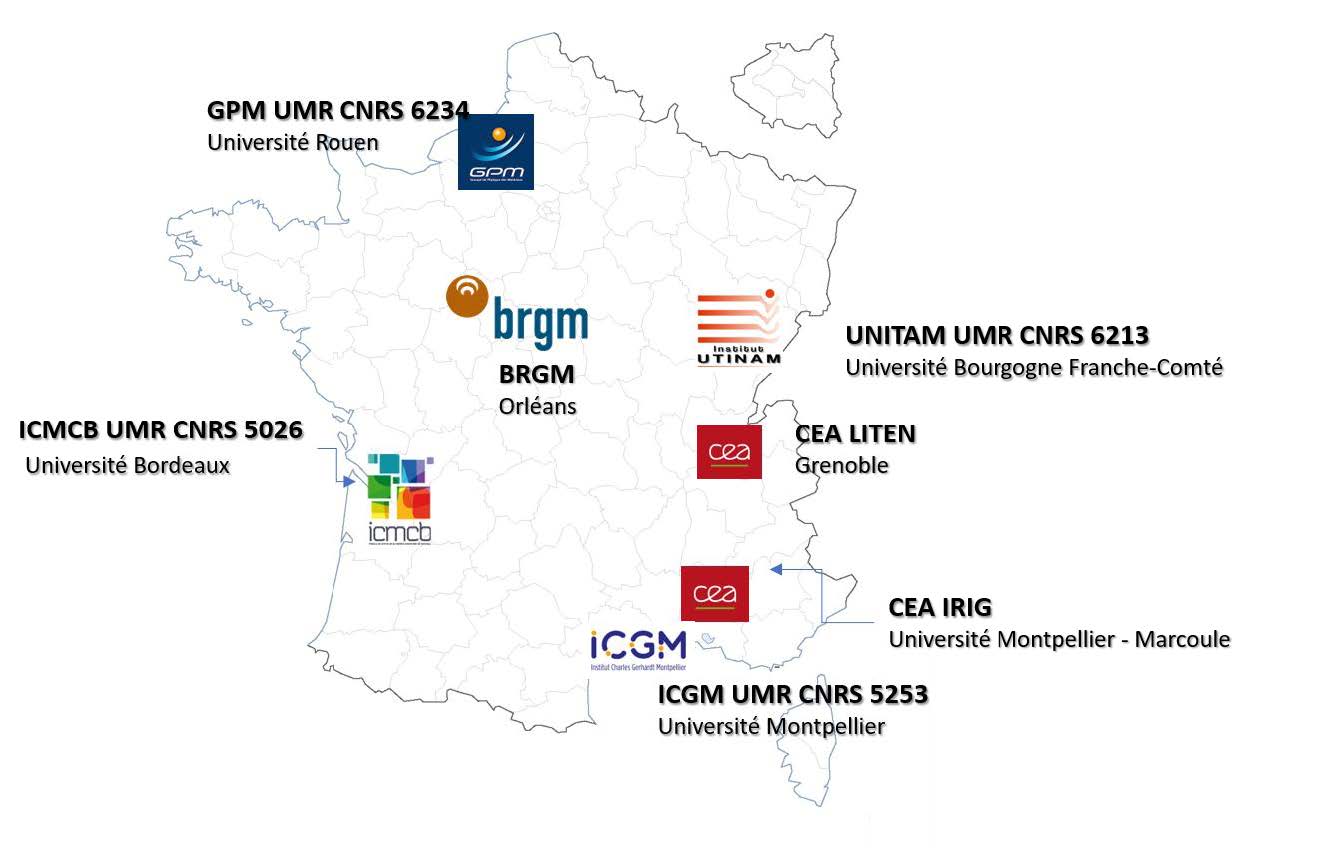
Consortium
Identify robust, sustainable solutions for adding value to the materials that make up energy systems (production, conversion). In concrete terms, this means developing and qualifying innovative, sustainable processes for the separation and purification of high value-added substances (metals, alloys, polymers) contained in the components to be recycled. This necessarily implies an understanding and optimization of the processes and their constituent stages. Generally speaking, this project will also contribute to a better understanding of the state of end-of-life components, and their level of degradation (of materials), enabling these end-of-life objects to be better directed towards the most suitable recycling process.
Promoting the use of green solvents (recyclable or regenerable) by limiting effluents in selected processes limits environmental impacts. The generic route, which aims to separate and recover high-value materials from components without degrading them and in a short loop, is a virtuous one. Also, using low-temperature, low-energy processes over a short period of time guarantees control and reduction of the impacts generated.
1 PhD, 2 post-docs
Recat-H2 – Project phase 2
Excerpt
Project : Recat-H2, recycling of water electrolyzer catalysts
Laetitia DUBAU, Research director CNRS (LEPMI)
Contact : laetitia.dubau@grenoble-inp.fr
Mireille TURMINE, Senior lecturer (LRS)
Contact : mireille.turmine@sorbonne-universite.fr
Launch date: 01/01/2026
Reference: ANR-22-PERE-0004
The RECAT-H2 project aims to propose recycling methods for electrocatalysts used in water electrolysers for the production of dihydrogen (H2). In an acidic environment, electrocatalysts based on metals that are scarce on the Earth’s crust, such as platinum and iridium, will be recycled using hydrometallurgical and electrochemical processes that are as environmentally friendly as possible, based on life cycle analysis results. The same philosophy will be adopted in alkaline environments for electrocatalysts based on transition metals such as nickel, iron, or cobalt, which, although more abundant, are considered critical by the European Union. This collaborative project also includes the remanufacturing of electrocatalysts with state-of-the-art performance, requiring a detailed understanding of the physico-chemical mechanisms involved.
Key words: Recycling, Water Electrolysis (PEMWE, AWE), Critical Metals (Platinum, Iridium), Strategic Metals (Nickel, Cobalt), Hydrometallurgical and Electrochemical Processes, Operando Characterization Methods, Closed Loop
Tasks
Our researches
Recycling of metals involved in alkaline electrolyzers (Ni, Co, etc.)
Mireille Turmine (LRS)
- Research into electrolytes enabling leaching and electroselective refining
- Study of the selectivity of alloy electrodeposits from the leaching solution using various techniques, including DHBT
Recycling of noble metals used in acid electrolyzers (Pt, Ir, etc.)
Laetitia Dubau (LEPMI)
- Highlighting structure-dissolution relationships
- Transferring optimized leaching conditions to aged technological electrodes
Validation of recycling processes
Mireille Turmine (LRS) et Laetitia Dubau (LEPMI)
- Re-manufacturing electrodes from recycled materials
- Validating processes in terms of electrochemical performance
Key numbers
Laboratories
Researchers
Total budget
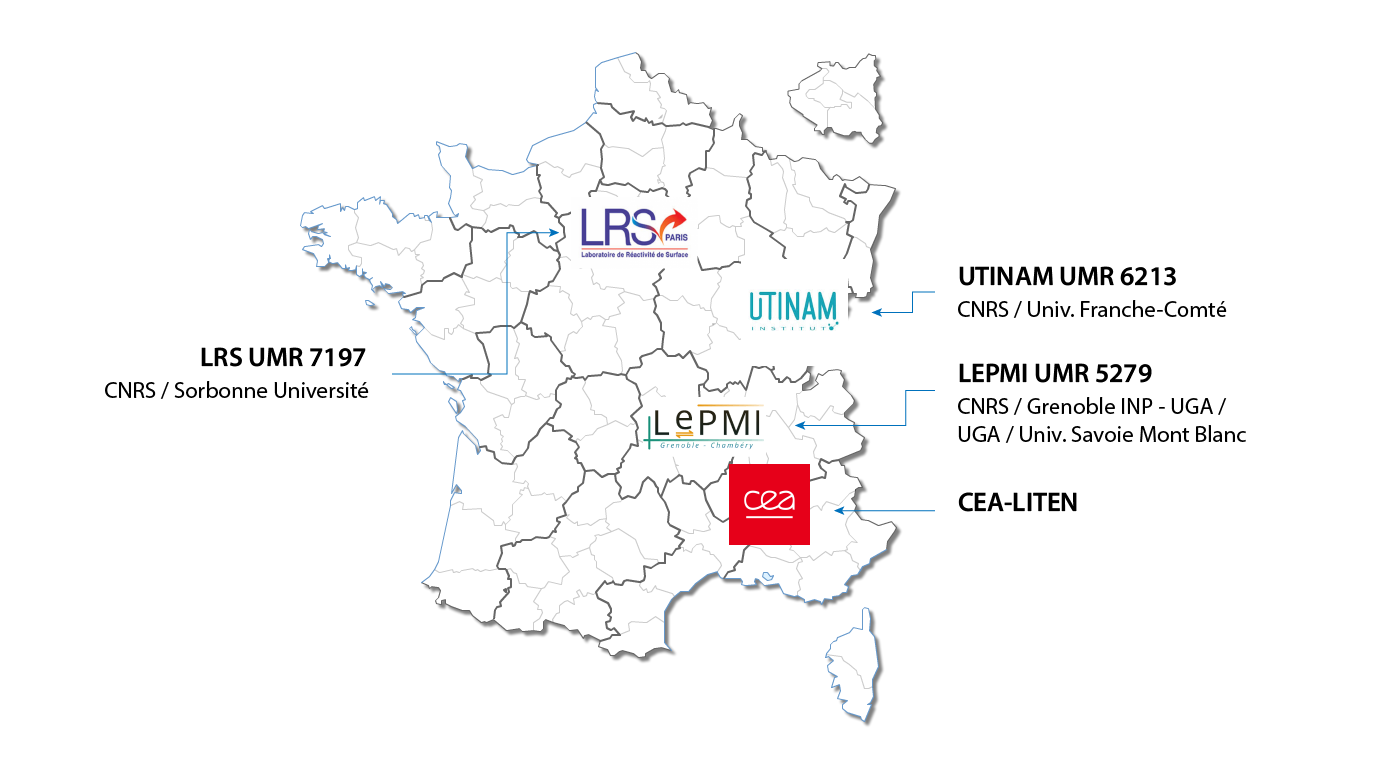
Consortium
- Obtaining metal dissolution protocols with yields ≥ 80%
- Designing metal recovery processes that comply as closely as possible with the principles of green chemistry through the choice of reducing agents, solvents, energy efficiency, etc.
- Designing electrocatalysts with performance similar to state–of–the–art materials.
The environmental impacts are cross-cutting throughout this project as a whole. The large–scale deployment of water electrolysis technologies to produce H2 cannot ignore the recycling of electrocatalytic metals. This project aims to recover them in the least impactful way possible. To do this, research will be guided by life cycle analysis methodology.
Two doctoral students and two master’s degree interns will be recruited to carry out this project.
The first doctoral student will be shared between LEPMI and CEA–LITEN to implement an effective process for recovering platinum and iridium salts. An M2 intern will support this thesis in the areas of remanufacturing and validation of recycled electrocatalysts.
A second doctoral student will be shared between the LRS and UTINAM to develop a process for limiting leaching to the catalytic layer and refining the target metals to a high purity in a second stage. An M2 intern will support this thesis with regard to the selective redeposition of metals.
Axis news
No news