
Strategic metals axis
Project Phase 1
Cyclamet
The general objectives of the Cyclamet project are to provide the framework for the socio-economic and environmental assessment of strategic metals recycling, and to develop unit operations to optimize the recovery and reclamation of metals contained in end-of-life objects.
Project Phase 2
CYCLALOOP
The CYCLALOOP research project aims to optimize the recycling of strategic metals present in various types of waste, while reducing their environmental impact. In addition to recovering the metals, the project studies their reintegration into new alloys or materials, and aims to assess the environmental impact of the solutions developed.
Cyclamet – Project phase 1
Excerpt
Project : Cyclamet, recyclage des métaux stratégiques
Yannick Menard (BRGM)
Contact : y.menard@brgm.fr
Stéphane Pellet-Rostaing (ICSM)
Contact : stephane.pellet-rostaing@cea.fr
Launch date : 01/06/2023
Reference : ANR-22-PERE-0003
The general objectives of the Cyclamet project are to:
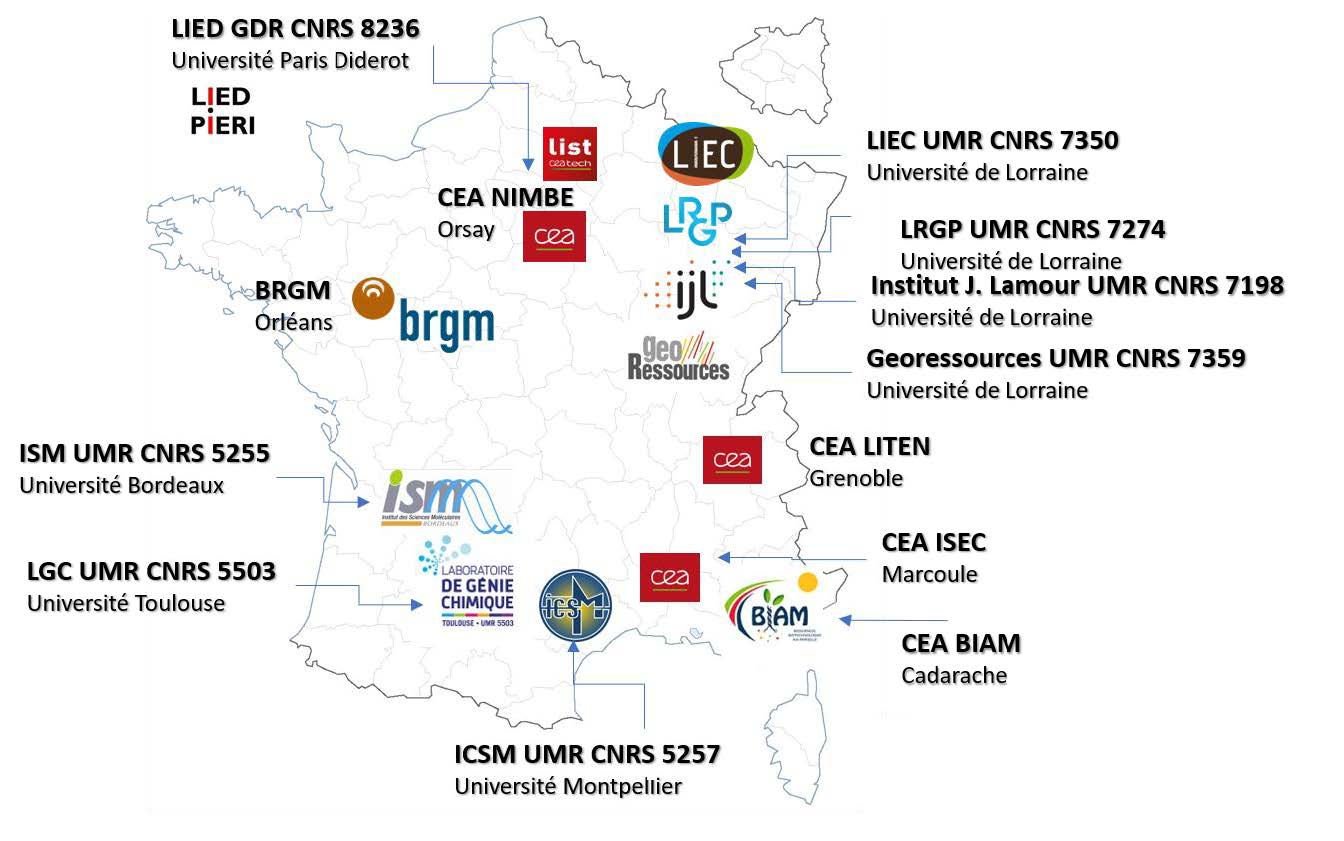
- Provide a framework for the socio-economic and environmental assessment of strategic metals recycling, including the development of environmental impact indicators to assess the sustainability of their management.
- Develop unit operations to optimize the recovery and valorization of metals contained in end-of-life objects, and to produce salts or marketable metals (purified, in alloy form),
- Provide tools and methods to feed other targeted projects,
- Provide other targeted projects with data on material composition and interconnections between phases (metallic, mineral, organic), reflecting the complexity of the matrices studied.
Keywords: Recycling, strategic metals, hydrometallurgy, automation, processes, sorting
Tasks
Our researches
Socio-economic and environmental assessment of strategic metals recycling
- Systemic approach to material and energy flows under stress for the recycling of strategic metals
- The recycling industry in Europe: Scandinavian countries at the forefront
- Implications of recycling strategies for the defense industry
- Development of environmental impact indicators for strategic metals management
Optimize automation and measurement time, with the aim of setting up on-line analysis systems for sorting adapted to recycling channels
- Target use cases to adapt the method (signal/noise, measurement time, shaping of the incident spectrum…)
- Spectrum processing for fast, accurate quantification of elements of interest
- Automation of the measurement process, with the aim of setting up a sizing support system (identification of atomic elements of interest to guide sorting / instrumentation / measurement optimization).
Develop soft chemical alternatives to existing complex and polluting hydrometallurgical processes for the recovery of strategic metals
- Evaluate the potential of industrial-scale preparative chromatography for metal extraction.
- Use ionic solvents and couple electrolysis and electrodeposition (EE) in a single cell as an alternative to conventional hydrometallurgical processes.
- Develop efficient and economically viable processes, aiming for lower effluent and waste production, energy savings and operator safety.
Develop innovative numerical tools to support the design and scale-up of hydrometallurgical processes for metal recycling, from leaching to separation and purification stages
- Develop a numerical tool to describe the various phenomena influencing the process and their coupling (case study: printed circuit board (PCB) waste).
- Predict the geometric properties of emulsions (interfacial area, breakage/coalescence sites) to enhance the reliability of predictions of M/S operation.
Tools for process optimization
- Development of microfluidic equipment for on-line measurement of parameters such as dissolved O2 and CO2, metal ion concentrations…
- Can Quorum Sensing be “gamed” to improve metal recovery from e-waste?
Key numbers
Laboratories
Researchers
Total budget
Consortium
Contribute to making the metals in our waste accessible by preventing their dissipation
Provide quantitative data to assess the value of recycling and its effect on the accessibility of metals
Understand the dynamics and interconnections between the production of secondary materials and the needs driven by the energy transition
Develop dedicated, clean, robust and agile processes at the interface between scientific fields, capable of adapting rapidly to changes in the composition of the urban mine and recovering a large number of metals present in our waste.
Soon to come
Training of 6 PhD students and 13 post-docs.
CYCLALOOP – Project phase 2
Excerpt
Project : CYCLALOOP, innovative recycling approaches and short loops for strategic metals
Mathilde Laurent-Brocq (ICMPE)
Contact : mathilde.laurent-brocq@cnrs.fr
Anne-Sophie Gay (IFP Energies Nouvelles)
Contact : anne-sophie.gay@ifpen.fr
Launch date : 01/03/2026
Reference : ANR-25-PERE-0008
The CYCLALOOP research project aims to optimize the recycling of strategic metals present in various types of waste (electronic boards, catalysts, industrial alloys, etc.), while reducing their environmental impact. Current recycling technologies have limitations, such as high metal losses and high energy consumption.
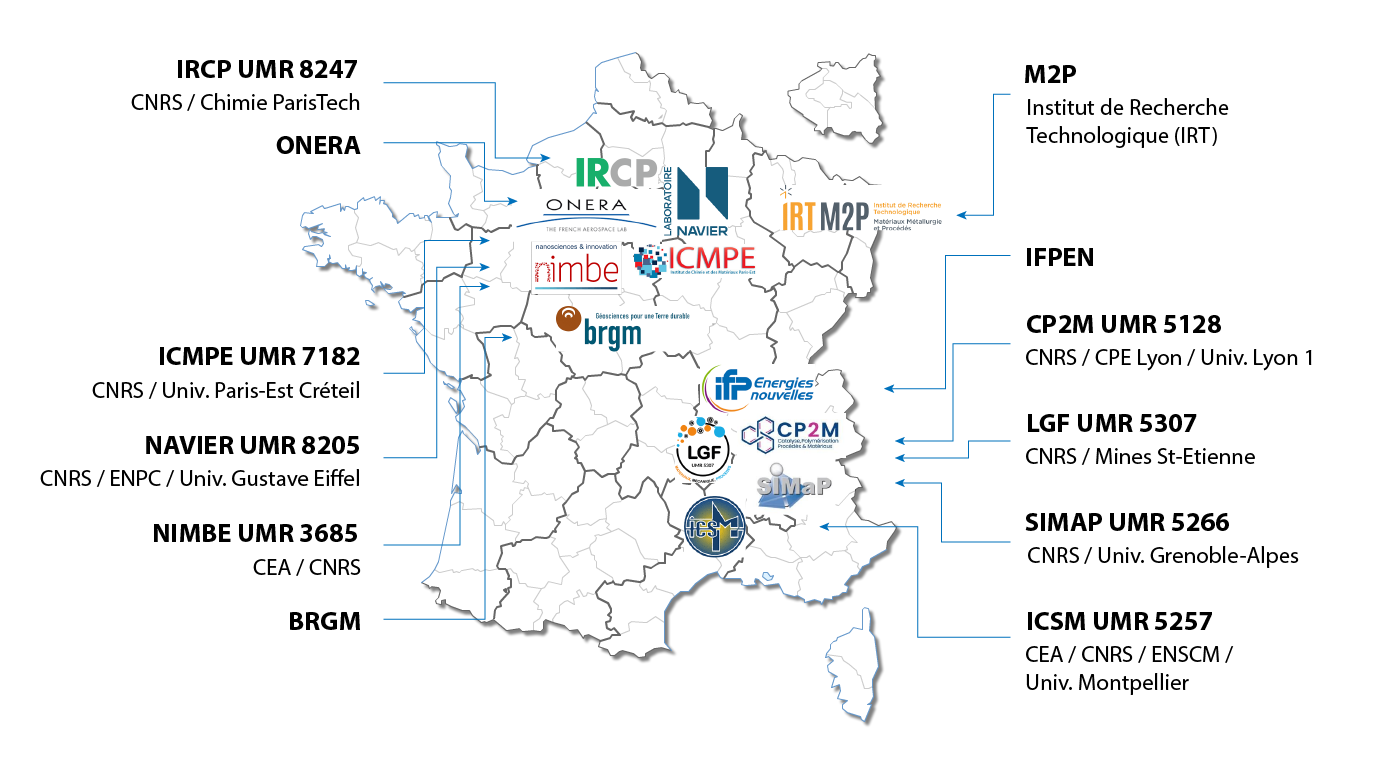
CYCLALOOP is exploring innovative processes, including salt solution treatments and advanced materials for capturing precious metals in low concentrations. It is also focusing on short-loop recycling schemes, integrating techniques such as solid-state recycling, biometallurgy and hydrometallurgy. In addition to recovering these metals, the project is studying their reintegration into new alloys or materials. A life cycle assessment will evaluate the environmental impact of the solutions developed. Supported by 12 partners from public and private research, CYCLALOOP responds to the urgent need to improve current processes and design viable large-scale technologies for a circular economy.
Keywords: Recycling, strategic metals, short loop, hydrometallurgy, biometallurgy, solid process
Tasks
Our researches
Solid state recycling
Mathilde Laurent-Brocq (ICMPE)
The aim of this task is to apply solid-state recycling to strategic manufacturing wastes and transform them into materials for structural applications with advanced properties. The focus is on titanium alloys, with two grades selected: Ti-64 (also known as TA6V) for its widespread use in aerospace and biomedical applications, and Ti-6242 for its higher compositional complexity. Two forms of waste will be studied: powders and chips. The main stages in the recycling chain and the final properties of the materials will be studied.
Innovative hydrometallurgy unit operations
Stéphane Daniele (CP2M)
This task develops hydrometallurgical unit operations to improve the recycling of critical and strategic metals, building on the foundations laid in Phase 1 of PEPR-Métaux Stratégiques. It introduces selective dissolution techniques and innovative nanomaterials (NOFs) to enhance metal recovery and achieve ultra-low metal concentrations in leachates. The brine-based approaches developed also complement Phase 1 work with other ionic fluids, creating a more complete toolbox for metal recycling.
Short-loop recycling of metals recovered by (bio)hydrometallurgical processes
Anne-Sophie Gay (IFPEN)
Task 3 focuses on the manufacture of materials from recycled metals. Two recovery chains are examined, either a generic short chain, where critical metals obtained by hydrometallurgical recycling are melted down to produce advanced alloys; or a closed-loop chain, where the polymetallic leachate solution is directly reused to reproduce a material of the same nature as that which, in its waste form, was recycled.
The successful recovery of recycled metals involves overcoming several key challenges: ensuring that the quality of materials derived from recycled metals is equivalent to that of primary metals; characterizing and quantifying impurities; and establishing tolerance thresholds to guarantee material performance. Modeling and simulation play a crucial role in this process.
Life cycle assessment
Gaël Fick (IRT M2P)
This task will use Life Cycle Assessment (LCA) to assess environmental relevance and guide technological and strategic choices. All the recycling routes studied in the other three tasks will be investigated and compared with primary metal/alloy production. To study these numerous processes with varying technological maturity, we will proceed in two stages: “screening” LCA to identify problem areas and levers for improvement; consolidated LCA.
Key-numbers
Laboratories
Researchers
Total budget
Consortium
The CYCLALOOP project will develop methodologies for recycling metals from various wastes. Proofs of concept will be presented on the following topics:
– Advanced solid-state recycling processes for manufacturing waste using extrusion and SPS technology
– Recovery of critical metals from e-waste via salt solutions
– Development of solutions for the recovery of strategic metals using nanomaterials engineering and ligand chemistry.
– Extraction of critical metals from electronic scrap and development of advanced alloys.
– Short-loop recycling of catalysts via bio-leaching.
The CYCLALOOP project uses Key Performance Indicators (KPIs) and Life Cycle Assessment (LCA) to identify the most promising recycling processes. The aim is to develop processes that reduce greenhouse gas emissions by 75% through the use of recycled metals, compared with primary extraction. In addition, the project aims to achieve a recycled material reincorporation rate of over 50% in short loops, thus contributing to a transition towards a more sustainable and circular economy.
Several young researchers (5 PhD or post-doc students and 3 interns) will be recruited for this multi-partner project, offering them a unique opportunity to work at the intersection of sustainability, materials science and industrial innovation. They will also develop interdisciplinary skills (such as life cycle assessment) and apply their knowledge to real-life challenges. Participating in this project will also enable them to network with leading institutions and industrial players, opening up promising career prospects.
Axis news
No news