Textiles axis
Project Phase 1
VLAN
The objective of the VLAN project is to propose different solutions so that each textile can be recycled in the most optimal way at the end of its life, according to its specific technical, aesthetic, and emotional characteristics.
Project Phase 2
CellUp
The CellUp project proposes using the “all-cellulose composites” approach to recycle cellulose-based textile waste, including cotton, linen, viscose, Tencel, and polycotton. Since cellulose is a non-fusible polymer, partial dissolution of the fibers will be used.
VLAN – Project phase 1
Excerpt
Project : VLAN, Valorisation des textiles, Recyclage, recyclabilité et réutilisation
Ludovic Koehl, Full professor (ENSAIT)
Contact : ludovic.koehl@ensait.fr
Sébastien Livi, Full professor (IMP, INSA)
Contact : sebastien.livi@insa-lyon.fr
Launch date : 01/02/2023
Reference : ANR-22-PERE-0006
The aim of this project is to propose different solutions so that each textile can have the most optimal end-of-life recovery according to its own technical, aesthetic and emotional characteristics.
The molecular solution consists in developing PET-based Covalent Adaptable Networks (CANs) for the implementation of eco-designed fibers and the recovery of polyester textile waste. These polymers are based on transesterification by reactive extrusion with epoxies in the presence or absence of ionic liquids.
At the level of textile materials, a decision-support tool for recycling choices will be developed. It is based on a detailed analysis of the fabrics contained in the deposits, including their structure, potential recycling routes and degradation. Criteria are developed and associated with descriptions of recycling processes. At the level of textile objects, the project takes into account the intrinsic qualities and values of objects and those perceived by consumers. Echoing the material revalorization processes, a socio-cultural analysis of the mechanisms by which consumers discard textile objects is carried out. This enables us to understand their practices in terms of recycling domestic waste. The textile designer’s point of view makes it necessary to predict its aspects, by characterizing and exploiting them as “material for creation”. This area examines different ways of overcycling, equipping them with creative tools.
Keywords: Textile, PET, vitrimers, deposits, decision support, LCA, overcycling, quality, value, neglect
Tasks
Our researches
Material by Design at molecular scale
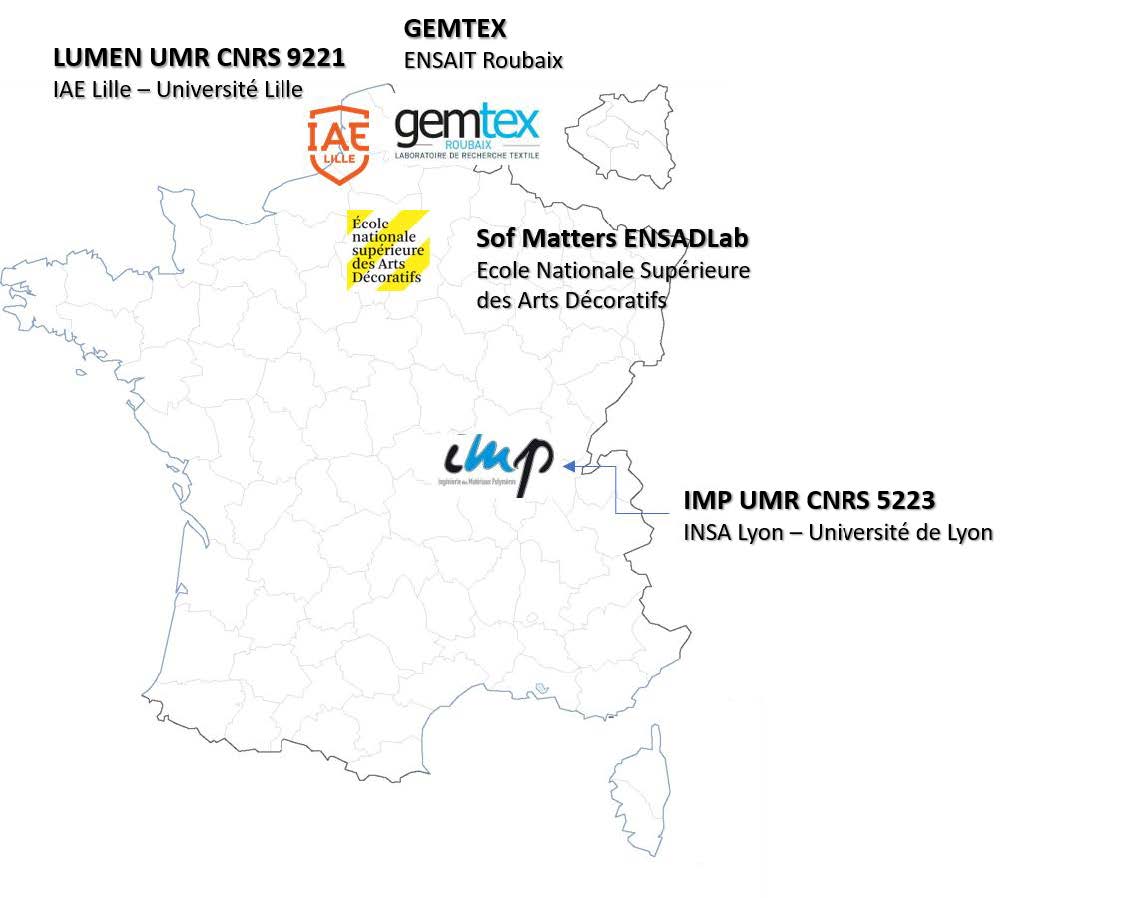
Sébastien LIVI, IMP Lyon
- Enhancing the value of recycled PET
- Designing recyclable PET by introducing dynamic bonds
- Synthesis of dynamic ionic bonds
- Structure-property relationships of eco-designed and recyclable PET
- Feasibility of spinning these polymers
Safe and Sustainable Recycling and transformation processes of textiles
Ludovic KOEHL, GEMTEX, Roubaix
- Mapping of end-of-life textile-clothing recovery routes (point 1)
- Socio-cultural analysis of consumer mechanisms for discarding textile objects (point 2)
- Definitions, prioritization and determination of weighting factors for the criteria used to assess end-of-life textile-clothing recovery routes (point 3)
- Implementation of a decision-support tool on near-optimal recovery routes for textiles-clothing based on the criteria in point 3.
At textile Object Scale, Safe & Sustainable design-led textile upcycling
Jean-François BASSEREAU, ENSADLab Paris
- Predictive pre-model for the evolution of natural dyes as a creative material (first POC)
- Architecture of the chromo chronological color chart as a creation tool in textile design
- Super-cycling experimentation on creative materials (values and sensory qualities) for textile objects to extend their premiere (3 POC projects).
Key numbers
Laboratories
Researchers
Total budget
Consortium
Area1: Development of Covalent Adaptable Networks (CANs) based on recycled PET – Partial depolymerization of PET – Use of PET/recycled PET-CANs blends to produce new textile fibers.
Axis2: Criteria for classifying discarded textiles to identify their recyclability potential – Study of garments abandoned by consumers – Decision-support tool for recovering garments.
Axis3: Illustration of the first law of life extension for textile objects – Tools to help in the creation of super-cycling textile objects – Methodology for life extension for textile objects, clothing and accessories.
Les avantages environnementaux de chaque solution proposée sera évaluée par la méthodologie de l’ACV. Selon la littérature, les bénéfices attendus dépendent non seulement du procédé de recyclage mais aussi du matériau remplacé, de sa nature (monomère, fibre, fil, tissu), de la proportion de remplacement et des opérations textiles évitées. Ces analyses environnementales guideront le choix des différentes filières de valorisation.
De plus, dans ce projet, des propositions seront faites pour prendre en compte la qualité des textiles dans l’ACV.
A PhD student in the field of dynamic chemistry of vitrimers, enabling the generation of networks with reversible links (CANs for Covalent Adaptable Networks) – associated with 2 Masters and a third concerning the spinning of these materials.
A PhD student in the field of sustainable textiles: eco-design for the recyclability of textile materials, life-cycle analysis, and decision-support tools for the recovery of textiles at the end of their life, in association with 2 Masters students.
A post-doctoral fellow in the sociological field of practice theory applied to clothing abandonment mechanisms and recovery practices.
A post-doctoral researcher in the field of design for the overcycling of textile objects, in association with several master’s and bachelor’s students for the production of POC objects.
CellUp – Project phase 2
Excerpt
Project : CellUp, Sustainable upcycling of cellulose-based textile waste
Tatiana Budtova, Research director (CEMEF, Mines Paris – PSL)
Contact : tatiana.budtova@minesparis.psl.eu
Launch date : 01/11/2025
Reference : ANR-25-PERE-0001
Global demand for textile products continues to grow, but only a small percentage of textile waste is recycled. Of all types of textiles, around 30% contain cellulosic fibers. Only around 15% of this type of textile is recycled, and barely 1% is recovered through upcycling.
The CellUp project proposes using the “all-cellulose composites” approach to recover cellulose-based textile waste, including cotton, linen, viscose, Tencel, and polycotton. Since cellulose is a non-fusible polymer, partial dissolution of the fibers will be used.
This approach will make it possible to produce different types of materials: by preserving the architecture of the original fabric; in the form of new structured composites; and in the form of 3D objects manufactured using additive manufacturing (“direct ink writing”). The new materials developed in this way will have applications in the textile, decoration, fashion, sustainable packaging, and furniture sectors, as well as in the composites sector.
Keywords: Cellulose-based textiles, dissolution, upcycling, structured composites, 3D printing
Tasks
Our researches
Kinetic dissolution of fibers and production of composites that respect the architecture of the initial tissue
CEMEF/Mines Paris
Build a “library” of correlations between tissue architecture, processing conditions (dissolution, cellulose regeneration, drying processes), and the properties of the resulting materials. In this approach, the tissue architecture will be preserved, with the dissolved cellulose forming a co-continuous phase with the fibers.
Extraction of elementary fibers from fabrics and production of composites reinforced with oriented plant fibers
CIMAP/UNICAEN
Develop materials based on unidirectionally oriented fibers extracted from textile waste.
3D composite objects produced from partially dissolved or undissolved short fibers
CEMEF/Mines Paris
Developing “pastes” based on cellulose solution and partially undissolved cellulose fibers, with rheological properties suitable for 3D printing (using direct ink writing, DIW) of self-supporting structures.
Key numbers
Laboratories
Researchers
Total budget
Consortium
Various new materials derived from cellulose-containing textile waste (natural and/or artificial fibers) will be prepared. The feasibility of producing materials from textile waste using an all-cellulose composite approach will be demonstrated. Several fundamental questions will be studied: i) correlation between fiber dissolution kinetics and material properties; ii) manufacture of composites from textiles combining cellulose fibers and synthetic polymers; iii) conditions for extracting and transforming fibers into all–cellulose composites; iv) 3D printing of objects from partially dissolved fibers from textile waste.
Recycling cellulose-based textiles using all-cellulose composites and “green” solvents allows textile waste to be recovered without the use of harmful chemicals, thereby limiting pollution and energy consumption. The solvents used will be environmentally friendly. This process promotes a circular and sustainable economy, reducing dependence on virgin resources and helping to reduce the carbon footprint of the textile sector.
- 2 doctoral students
- 2 post–docs

Axis news
No news