Humanities and social sciences
axis
Project Phase 1
SO RRYL
The SO RRYL project, “a reuse and recycling society”, questions the socio-technical, socio-economic and socio-political evolution of waste management, including reuse and recycling.
Project Phase 2
RECYCLASH
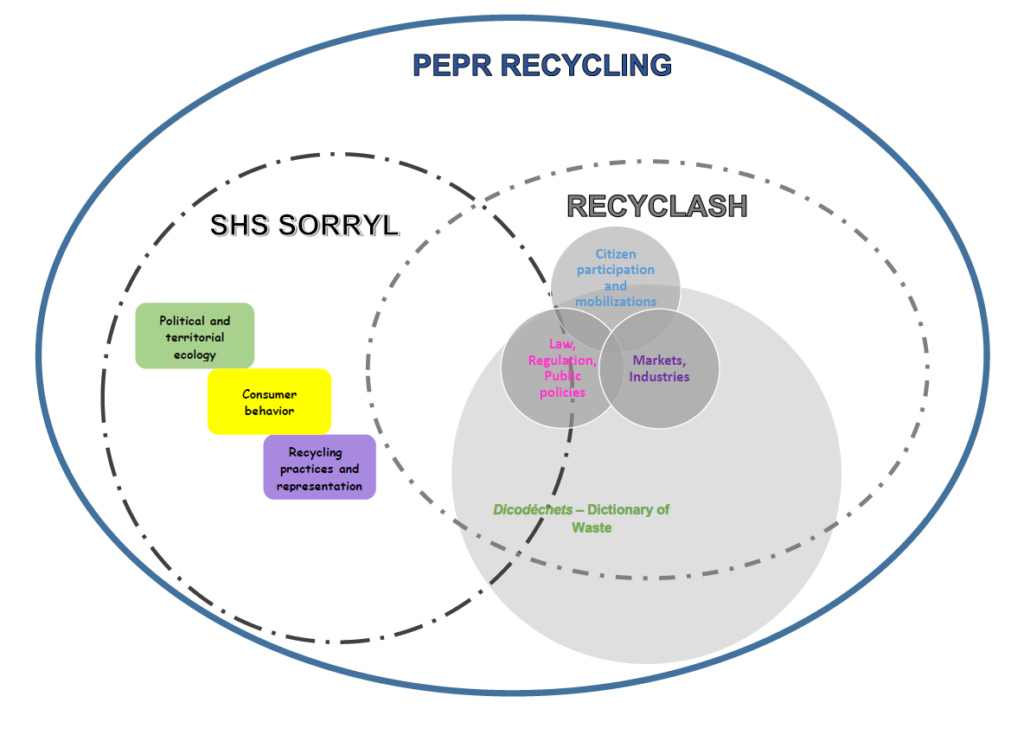
RECYCLASH is an interdisciplinary HSS research project (in particular, anthropology, graphic arts, geography, history, legal sciences, political sociology, economic sociology) dedicated to the study of the acceleration and brakes on recycling today.
SO RRYL – Project phase 1
Excerpt
Project : SO RRYL, Une SOciété du Réemploi et du RecYcLage?
Jean-Baptiste Bahers, researcher CNRS
Contact : Jeanbaptiste.bahers@univ-nantes.fr
Mathieu Durand, Professor (Université du Mans)
Contact : Mathieu.Durand@univ-lemans.fr
Reference : ANR-22-PERE-0011
Waste management and recycling are major concerns in the move towards a “truly” circular economy. There are many technological challenges involved in developing reusable packaging, improving product recyclability and incorporating recycled materials. However, these challenges will only remain theoretical if fundamental reflections are not carried out on the place of waste in our societies, on the relationship to materiality that its existence induces, and if consumption patterns are not questioned. The relationship between waste and society and the individuals who make it up, the way in which public policy deals with these issues, the territorial structuring of industrial sectors – these are all questions on which the social sciences can build knowledge. How does or should waste circulate in today’s world, given the imperatives of sustainable development? What is the environmental, ethical, economic and social significance of the circulation of waste?
By mobilizing scientific literature on the political economy of urban production and on major technical networks, political and territorial ecology, consumer behavior, new business models, and the ethical, moral and political issues surrounding waste, this project questions the socio-technical, socio-economic and socio-political evolutions of waste management, including reuse and recycling.
Keywords: society, reuse, circularity, consumption, public policy, territories, industrial sectors, waste flows, political ecology, sustainable development
Tasks
Our researches
Political and territorial ecology of recycling: actors, territories and uses
Jean-Baptiste Bahers (ESO)
- Questioning the spatial and social dimensions of material loops
- Recycling from the angle of plural governance regimes of circularity
- Clean, recycle and reuse: the greening of urban waste management in question
Consumer behavior, new roles for public and private players
Nathalie Lazaric (GREDEG)
- Examining opportunities for behavioral change using non-monetary tools
- Environmental regulation and business model innovation through standards
Recycling practices and representations in the Anthropocene
Laurence Rocher (EVS)
- Formal vs informal: an analysis of waste practices
- The peripheral territories of waste
- Material properties and material politics of waste
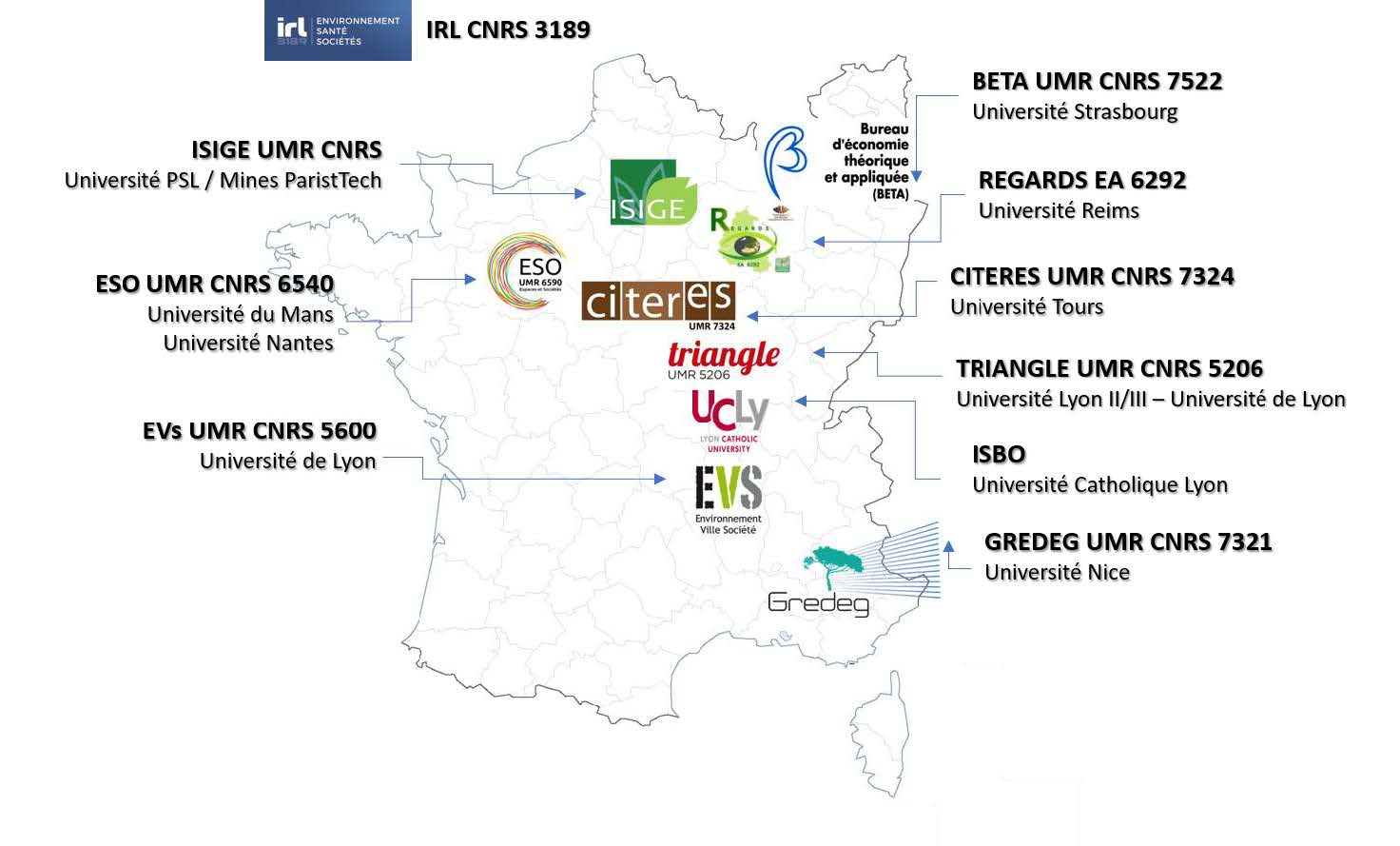
Key numbers
Laboratories
Researchers
Total budget
Consortium
Soon to come
Soon to come
Soon to come
RECYCLASH – Project phase 2
Excerpt
Project : RECYCLASH, recycling under stress
Isabelle HAJEK (SAGE, Université de Strasbourg)
Contact : hajek@unistra.fr
Claudia CIRELLI (CITERES, Université de Tours)
Contact : claudia.cirelli@univ-tours.fr
Launch date : 01/01/2026
Reference :
Recycling is going through a transitional phase, marked by progress but also severe limitations in the face of the 2030 European targets. Between recovery difficulties, sustainability issues and social and environmental criticisms, it is in the midst of an “Act II” requiring economic, legal and social readjustments. These transformations are producing new productive arrangements, new technologies and practices, as well as controversies over recyclability, health and environmental impacts and social representations of waste.
The RECYCLASH project aims to analyze these reconfigurations through three key areas: forms of commitment, legal frameworks, and the role of industrial players and consumers. The aim is to understand how players adapt to the constraints of acceleration and sustainability. The project is also developing a didactic and operational dimension, mobilizing the visual arts to raise awareness of recycling issues, and proposing an original mechanism for disseminating knowledge, the Dicodéchets, in order to strengthen the dialogue between science and society and promote new material cultures oriented towards sobriety.
Keywords: Recycling – commitment – collective action – legal and practical frameworks – industry – innovation – digital dictionary – mediation
Tasks
Our researches
Transforming forms of commitment and collective action
Fabrizio Maccaglia (Fabrizio.maccaglia@univ-paris8.fr)
The first task of Recyclash aims to investigate the renewal of forms of commitment and collective action in an unprecedented context of recycling under stress, through 3 focal points: 1) the rise of citizen initiatives in waste prevention, recycling and reuse; 2) the rise of environmental justice issues via the mobilization of solidarity players, in particular Emmaüs, around a committed craft (craftivism) of overcycling (textile, wood); 3) committed consumption and the transformation of consumer representations and perceptions of recycled textiles.
Recycling and reuse put to the legal test
Corinne Manson (corinne.manson@univ-tours.fr)
The second task analyzes the central role of law in regulating reuse and recycling. The legal issues involved in recycling and reuse are manifold, and partly determine the development of these sectors. Regulatory frameworks oscillate between incentive mechanisms, which currently dominate, and more restrictive measures, which can be based, for example, on public procurement or planning rules for materials from the construction sector, while raising the question of sanctions. Furthermore, economically relevant and socially desirable choices may come up against existing legal constraints, particularly with regard to liability and insurance law.
The agri-food industry’s political and commercial strategies in the face of intensified recycling
Jean-Baptiste Paranthoën (jean-baptiste.paranthoën@inrae.fr)
Sebastian Billows (sebastian.billows@inrae.fr)
Task 3 analyzes how large-scale economic players are responding to “3R” public policies aimed at promoting packaging reduction, recycling and reuse. It focuses on the agri-food industry, a major user and producer of packaging, which has to balance “3R” objectives with competitiveness issues and compliance with hygiene and traceability standards. The WP will describe the influence of manufacturers in decision-making circles in order to influence the interpretation and implementation of legislation, as well as their innovative approaches to developing new packaging solutions, sometimes in conjunction with specific suppliers.
Re-imagining recycling: in words and images
Isabelle Hajek (hajek@unistra.fr)
Claudia Cirelli (Claudia.cirelli@univ-tours.fr)
Task 4 proposes the implementation of interfaces and actions focused on raising awareness and transmitting knowledge and know-how about waste likely to foster a culture of recycling, and more broadly, a new material culture. The project is divided into 2 parts, carried out in collaboration with the Haute École des Arts du Rhin (HEAR): 1/ The creation of a digital dictionary of rudological humanities and leftovers – the DICODÉCHETS, hosted by Huma-Num, with the aim of giving greater visibility to the renewal of waste studies in SHS in the French academic space; 2/ The creation of mediation devices aimed at a wider public (decision-makers, citizens, economic players…): a) graphic reports and video clips on the players, practices and processes of recycling, based on the Recyclash survey fields; b) a reusable, itinerant exhibition on the Recyclash results; c) a Recycling Atlas to analyze and deconstruct discourses on recycling.
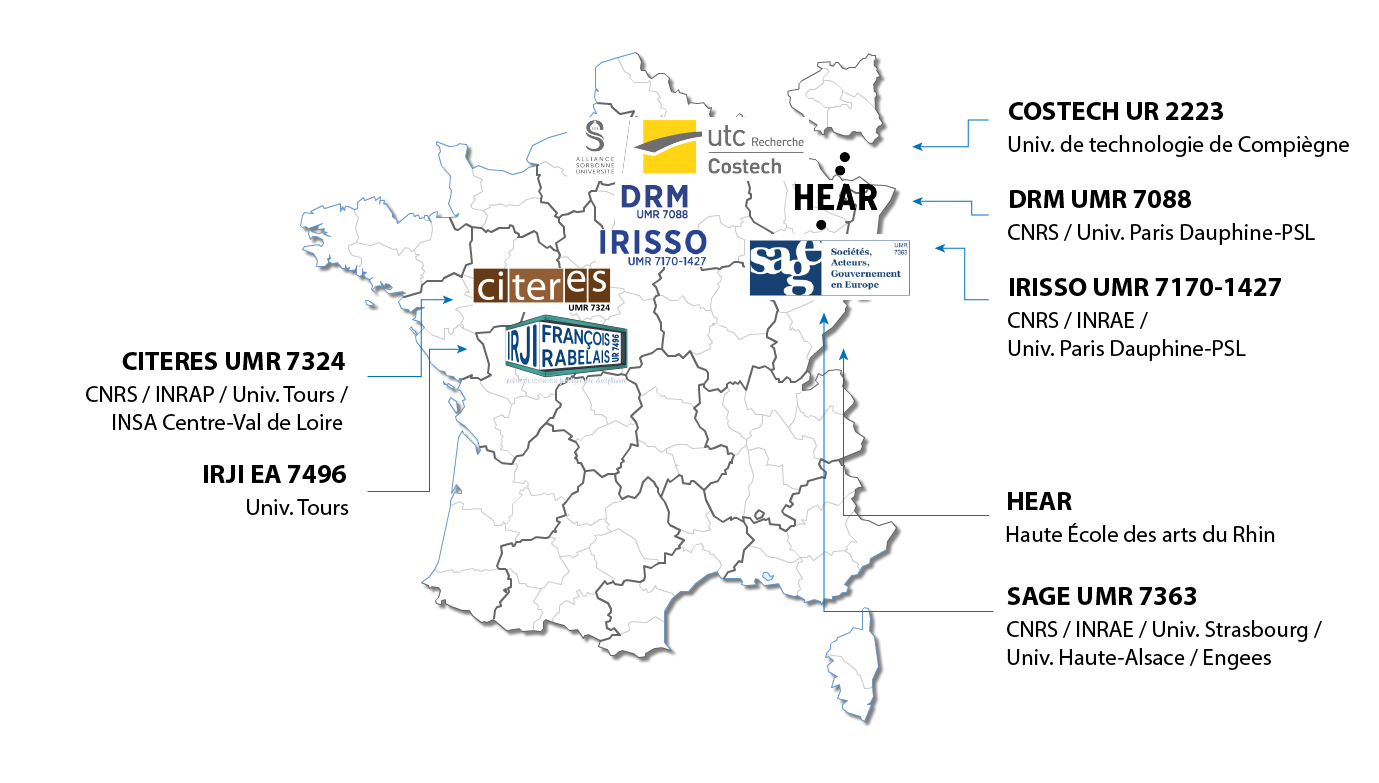
Key-numbers
Laboratories
Researchers
Total budget
Consortium
RECYCLASH mobilizes the analysis of opportunities, challenges and tensions in the recycling sector. It explores new fields – the renewal of commitments and militantisms, the legal framework for recycling and reuse, and industrial responses to increasing flows – in order to produce knowledge on the mechanisms of innovation and adaptation by players in a context marked by sustainability issues and intensifying flows. At the same time, the project generates didactic tools based on the visual arts to document and disseminate alternative material cultures. The Dicodéchets project represents a unique interface between science and society, enabling interdisciplinary knowledge to be shared and valorized.
The project sheds light on appropriation and innovation practices that reduce losses of recyclable materials and consumption of primary resources. By questioning the relationship between waste and consumption, it can limit demand for new goods and the associated flow of materials. Identifying new industrial and social practices stimulates the adoption of more efficient technologies, reducing energy consumption and recycling-related emissions. Didactic tools and visual arts promote sustainable behaviors (maintenance, repair, reuse). The knowledge generated can guide public policy on the sustainability and efficiency of recycling channels.
For the development of SHS skills:
- 1 doctorate (IRJI)
- 3 IR (SAGE, IRISSO, CITERES)
- 2 interns (SAGE)
For the development of graphic arts skills:
- Didactic workshop for 2nd year HEAR students
- 1 webmaster and 1 graphic designer
Axis news
No news